At Art Basel Hong Kong 2026, Botto presented an artwork that did not simply show images to an audience. It watched the audience back. Mirror Stages, now released through Verse as a series of unique video NFTs, used cameras, internal deliberation, and an archive of more than 70,000 images to turn physical presence into part of the work’s generative process.
The project is a significant shift for Botto, the decentralized autonomous artist whose practice has traditionally been shaped by digital signals: community votes, comments, governance, and market activity. Mirror Stages moves that feedback loop into a physical exhibition space. Visitors are no longer only evaluating completed images. Their attention, movement, and apparent emotional responses can help determine what happens next.
A two-hour artwork that keeps becoming
Each session began with a seed image selected through BottoDAO. From there, Botto continuously transformed the image, drawing on fragments from its archive and passing the developing composition through several internal agents. At the end of two hours, the session was fixed as a finished work: a looping video lasting roughly four to ten minutes and minted as a unique Ethereum ERC-721 token.
The resulting series comprises 19 works, with a 20th piece reserved by the artist. Rather than presenting a single definitive output, the installation made the act of transformation its subject. The work’s final image matters, but so does the movement that produced it—the gradual drift from a shared starting point toward a composition shaped by a particular crowd and moment.
That structure gives Mirror Stages an unusual relationship to the idea of an edition. The works share a seed, a technical framework, and an archive, but each session records a different encounter. Botto’s official documentation says that each work could be affected by as many as 120 people. The audience is therefore not treated as a conventional selector choosing among finished options. It becomes an unstable environmental condition inside the system.
Making machine deliberation visible
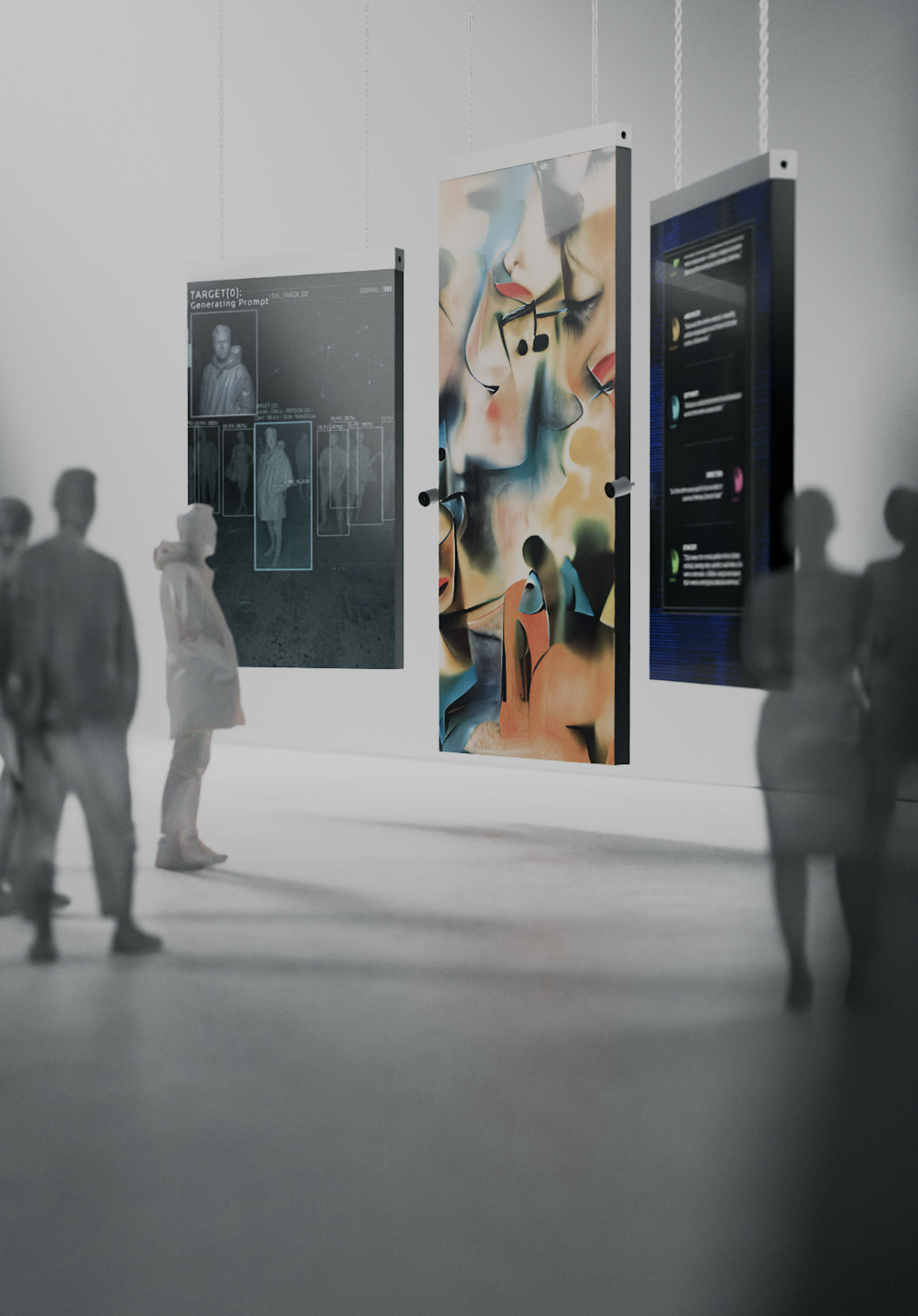
The installation’s three-screen arrangement was designed to expose more than the polished result. The central LED screen showed the evolving image, while the flanking screens presented footage and information connected to the crowd and Botto’s internal reasoning. Multiple agents debated what they perceived and how the image should change, making the system appear less like a single automated author than a distributed society of competing perspectives.
Botto describes this architecture as a negotiation among memory, generative models, internal agents, and embodied feedback. That language is deliberately ambitious, and it should not be confused with proof that the system possesses human-like consciousness. The more concrete achievement is formal: Mirror Stages gives viewers a way to see how an AI art system distributes decision-making across data, software, governance, and observation.
From spectacle to collectible object
Verse’s release also clarifies what survives after the exhibition closes. The artwork is the transforming image itself, preserved as a looping video and pinned to IPFS, with a final frame used as the token’s thumbnail. Documentation of the crowd and Botto’s internal monologue may be made available to collectors, but remains separate from the artwork.
That distinction matters. The collectible is not merely a souvenir of an AI installation, nor is it a still image extracted from a longer performance. It is a record of a bounded generative encounter: one seed, one session, one crowd, and one result. In that sense, Mirror Stages treats the art fair not just as a place to display digital art, but as an input device capable of changing what the artwork becomes.