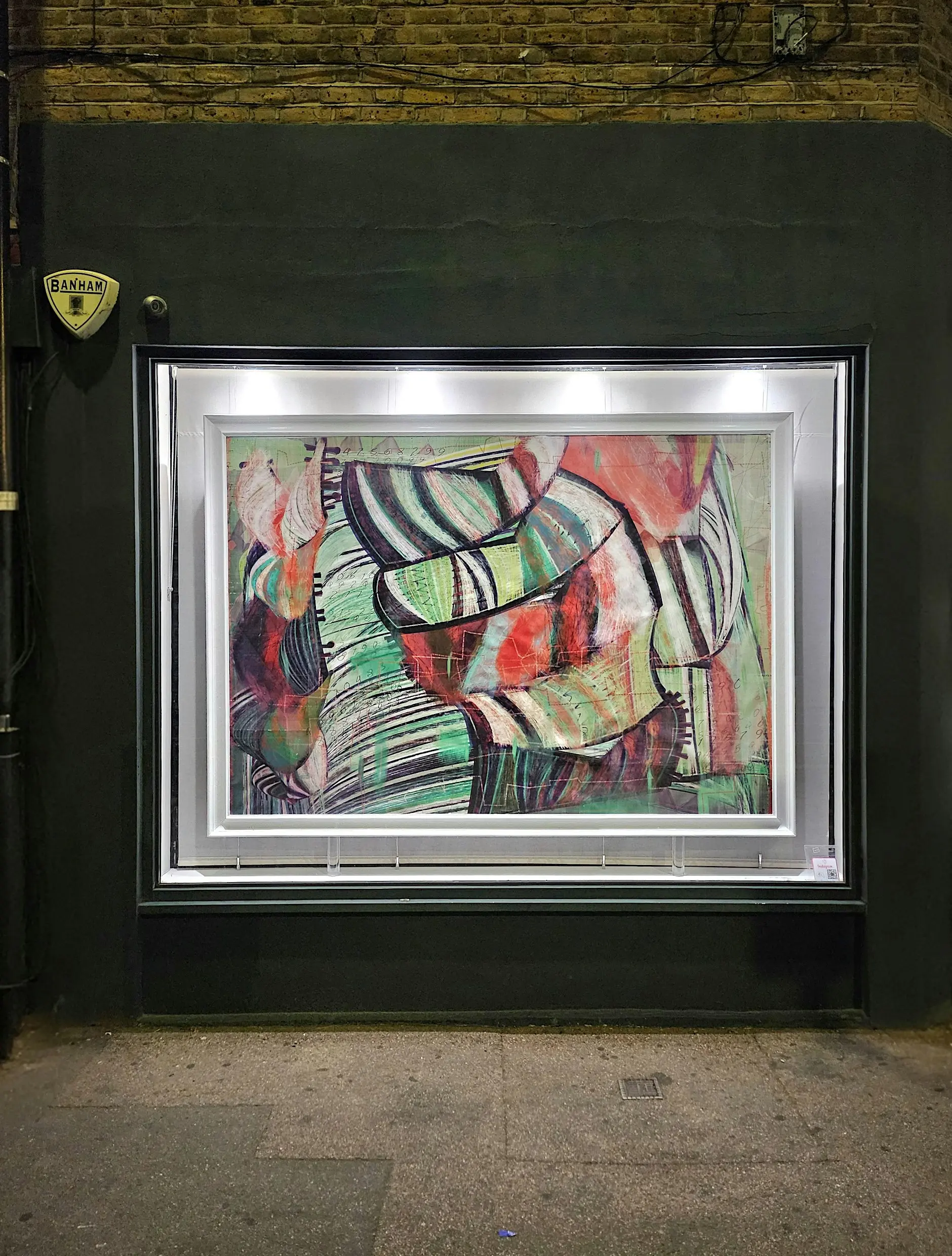
Harvey Rayner’s Painting with Code tests how generative art changes when algorithms move from screens into gallery objects.
- The London exhibition pairs code-based practice with physical works.
- Rayner treats code as a direct craft rather than an autonomous maker.
- Large prints make systems of constraints visible through color and scale.
Harvey Rayner’s next exhibition begins with a familiar problem in generative art: how do you show work whose real subject is a system rather than a single image? Painting with Code, scheduled for October 13–18 at Gallery Renaissance in London, will place Rayner’s code-based practice alongside large-format works, framed prints, and digital presentations during Frieze Week. The opening is planned for October 13 from 6 to 8 p.m., according to the event announcement.
The show is a useful test of what generative art gains when it leaves the browser. Rayner has spent more than three decades working with mathematics, algorithms, and code, but he does not describe the computer as an autonomous image-maker. He builds the rules, adjusts them, and looks at what they produce. The physical works are therefore not illustrations of software. They are another way of giving a software process a body.
When Code Leaves the Browser
Code as a direct craft
Rayner’s own description of his practice is unusually plain. On his website, he calls code “the most direct way” for him to shape marks and composition. He compares the process to drawing and painting: the artist works through a medium, receives feedback from it, and decides what to do next.
That distinction matters at a moment when generative art is often explained through the language of automation. Rayner does use AI for limited supporting tasks, including automating parts of printing and learning more efficient coding methods. But he says he has no desire to put it inside the central feedback loop of his practice. For him, the pleasure is not only in the result. It is in the repeated act of building a system, looking at its behavior, and refining the next decision.
This is also why the move into physical space is more than a change of format. A screen can make code disappear behind an image. A large print makes the system’s decisions visible as color, texture, repetition, and scale. It asks the viewer to look at the output as a composition while remembering that the composition came from a set of constraints.
From participation to presentation
The Gallery as a Generative Display
Rayner’s recent work has already tested how much of a generative artwork can be shared with its audience. His Algorithmic Synesthesia project, presented by Art Blocks at Art Basel Hong Kong in March, invited visitors to help seed the generation of new works through an interface. Art Blocks framed the project as an introduction to generative art and on-chain ownership for collectors encountering the medium in a fair setting.
Painting with Code changes the emphasis. The visitor is no longer primarily a participant initiating an output. The gallery becomes the place where a family of outputs can be compared, enlarged, and considered as objects. That shift brings generative art closer to the habits of painting: attention moves from the mechanics of production to the decisions that the mechanics make legible.
There is a risk in that translation. A print can make a generative work easier to live with, but it can also flatten the movement and variation that give the system its character. Rayner’s answer is not to hide the code. It is to treat code as the equivalent of a brush or a set of studio tools, something that can be handled directly and judged by the images it makes possible.
The exhibition will not settle the larger argument over whether generative art belongs in the gallery. It does offer a specific proposition: code can be both an engine and a material, and the difference becomes visible when the work is large enough to occupy a room.
Painting with Code runs October 13–18, 2026, at Gallery Renaissance in London. The event page lists the planned opening and RSVP details.