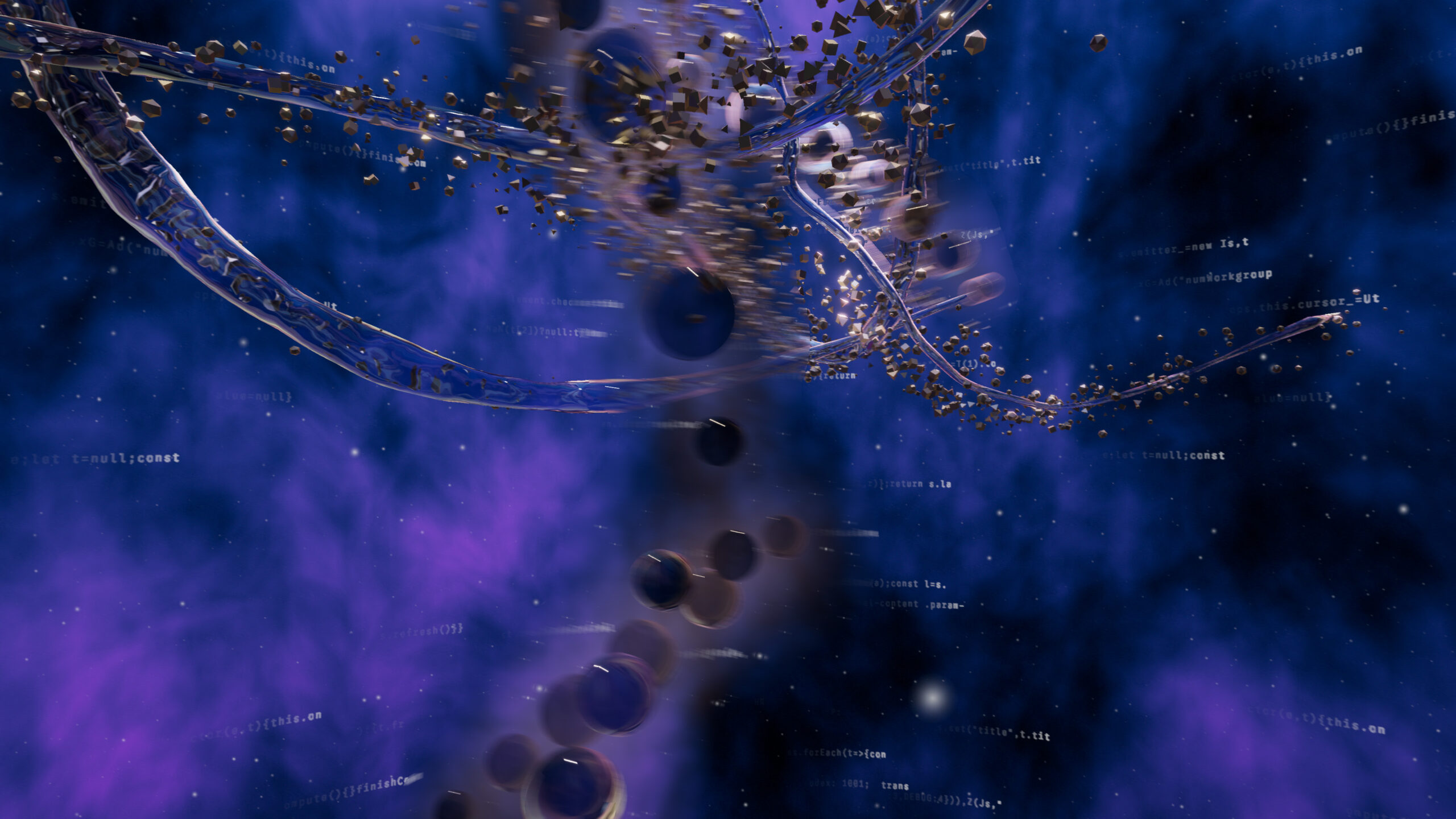
The Thinking Ocean turns a Whitney artport commission into a meeting point for fluid simulation, poetry, and questions about natural intelligence.
- Memo Akten and Katie Hofstadter build a navigable underwater system.
- Procedural currents make computation feel like an environmental force.
- A nonlinear poem and WebGPU rendering keep the work in motion.
The newest digital commission on the Whitney Museum of American Art‘s artport does not present the ocean as a backdrop. In The Thinking Ocean, artists Memo Akten and Katie Hofstadter build a navigable underwater world in which currents, code, sound, and language behave as parts of the same system.
The work is part of the artists’ Cosmosapience series and one of two commissions the Whitney lists for artport in 2026. The other, Leo Castañeda’s Camoflux Recall Grotto, takes the form of a web-based game. The Thinking Ocean is less interested in game objectives than in a change of perception: it asks viewers to move through an environment that is always becoming something else.
Water as a computational landscape
A landscape made from rules
At first, the work resembles an underwater scene. Particles drift through the frame, bubbles gather and disperse, and currents pass through a space that feels organic without pretending to be a documentary image of the sea. As viewers navigate, the environment becomes more abstract. Shapes recall cells, circuitry, and fragments of computer code.
The transformation is not simply visual. The Whitney describes the ocean and the computer as expressions of related principles: both can store, transmit, and move information. The work’s fluid behavior is generated procedurally, so the image is not a fixed animation playing behind the visitor. It is a system responding in real time.
A barely visible humanlike figure produces currents as it moves. That detail gives the environment a body, but not necessarily a human one. The figure is less a character than a disturbance, a way of making invisible forces perceptible. The viewer does not watch an ocean from outside; the viewer enters a set of conditions and learns its behavior by moving through it.
The museum also connects the piece to research into fluid dynamics, including the Navier-Stokes equations that describe the movement of fluids such as water and air. The Whitney says that these equations can, in principle, perform any computation a digital computer can perform. That is a striking claim, but the artwork does not need it to function as a scientific demonstration. Its more interesting move is cultural: it reverses the familiar language of artificial intelligence. Instead of asking whether machines can become more like living things, it asks why living systems are so often treated as if they were not already computational.
Language that refuses a straight line
The work’s voice does not narrate the scene or explain what visitors should think. A nonlinear poem is generated in real time and recited as the environment shifts. The result, at least in the museum’s account, is a voice that belongs to the system rather than sitting above it as a guide.
That choice matters. Digital artworks often use language to stabilize an unstable image, giving the visitor a clear interpretive route. The Thinking Ocean appears to do the opposite. Its poem is another moving layer, subject to the same questions of order, pattern, and emergence as the water and the code.
Akten and Hofstadter developed the commission with choreographer and motion-capture artist Alexander Whitley, musician and sound artist Paige Emery, WebGPU consultant Niklas Niehus, and studio assistant Milana Aernova. They also worked in dialogue with researchers at the Scripps Institution of Oceanography’s SOARS Lab. The collaboration places the piece between artistic research and technical production without reducing it to either one.
The browser becomes part of the ocean
The technical threshold is real. On Apple devices, the Whitney says, The Thinking Ocean requires the WebGPU API and iOS 26 or macOS 26 or later. That requirement is easy to read as a compatibility note, but it is also part of the work’s subject. The ocean here is not an image that happens to be delivered by a browser. It is a computation that must be performed by the visitor’s machine.
That dependency gives the commission an understated tension. The work argues for attention to the intelligence of natural systems while asking a contemporary graphics processor to make that argument visible. The ocean may be the subject, but the browser is one of its instruments.
The Thinking Ocean is available through the Whitney’s artport commissions program.