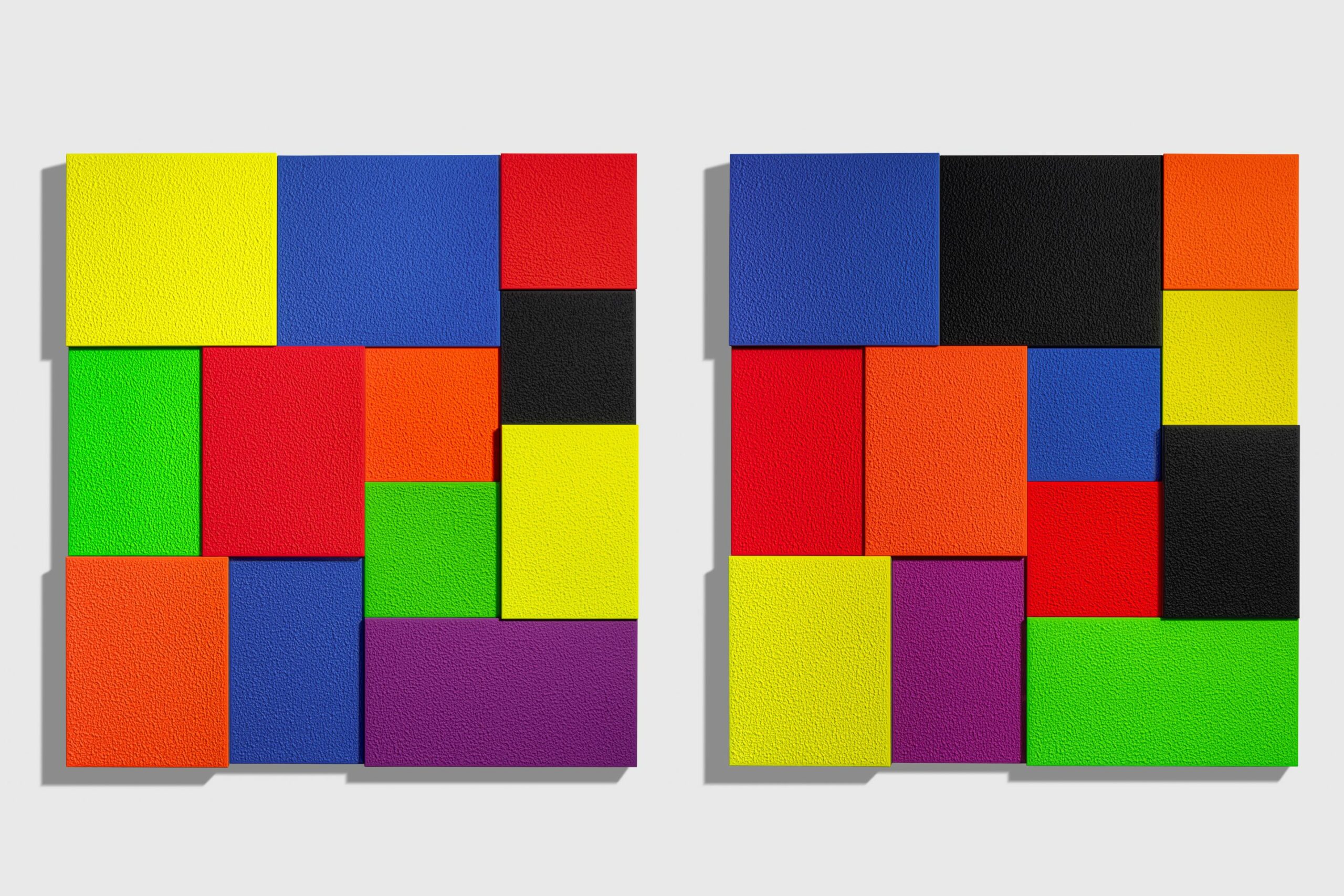
Peter Halley’s new editions use digital rendering to reproduce the physical logic of his paintings, then return the image to the hand.
- Rebus I and Rebus IV are limited editions of 20.
- Digital processes establish texture, relief, and structure.
- Hand-painting keeps the finished works from becoming simple reproductions.
Peter Halley’s paintings have long treated the grid, the cell, and the channel as more than formal motifs. They are diagrams of how people move through regulated spaces. In his latest Sotheby’s Exclusive Editions, that language passes through a digital process before returning to the physical object, creating a hybrid that is neither a conventional print nor a purely digital artwork.
Rendering the logic of a Halley painting
The series includes Rebus I and Rebus IV, both dated 2026 and described by Sotheby’s as limited editions of 20. The works draw on Halley’s longstanding use of Roll-A-Tex, the industrial paint additive that gives his surfaces their distinctive relief. Instead of treating that texture as something a camera can merely document, the edition process digitally renders the surface and its structure across twelve individual cells.
That decision is significant because Halley’s paintings depend on the friction between diagram and material. Their geometric clarity suggests a system, while the rough, granular surface insists that the system has been built by hand. Digital rendering can reproduce the pattern and simulate the relief, but it also risks turning the work into an image of itself. The editions address that risk by keeping physical finishing inside the process.
At the LITO Tech Lab, the digitally established texture, relief, and structural framework are hand-painted. The result is a work whose first decisions are computationally organized but whose final surface remains subject to touch, pressure, and variation. The technology is not hidden, yet it does not claim authorship. It acts as a way to extend an existing visual grammar into another production method.
Why the hybrid object matters
Halley’s paintings have often been discussed through their connections to architecture, communications systems, urban environments, and digital networks. The new editions make that relationship literal without reducing it to a novelty. A process that begins with a digital model and ends with a hand-finished surface mirrors the hybrid infrastructure that Halley’s imagery has described for decades: abstract systems become real through the material channels that carry them.
The editions also complicate the usual hierarchy between “original” and “reproduction.” A limited edition is not an original painting, but neither is this series simply a mechanically repeated image. Each work is built from a controlled framework and then materially completed. Its identity depends on the interaction between the repeatable structure and the embodied finish.
That distinction is especially relevant as digital tools become normal in the production of physical art. The important question is no longer whether a work used software somewhere along the way. It is what the software made possible, what remained deliberately analog, and whether the two stages produce a meaningful tension. In Halley’s case, the digital layer clarifies the architecture of the composition while the hand restores the evidence of labor.
The Sotheby’s project is therefore less a digital-art crossover than a study in translation. Halley’s cells, lines, and surfaces move through a machine and come out insisting on their materiality. The editions suggest that a digitally organized artwork does not have to abandon the irregularities that make an object feel made.