Anthony McCall’s “solid light” films turn projection into a physical environment, asking viewers to move through images rather than simply look at them.
- The Centre Pompidou is presenting four works at Ircam.
- McCall’s practice makes the beam itself the subject.
- Visitors complete the work through movement and shared space.
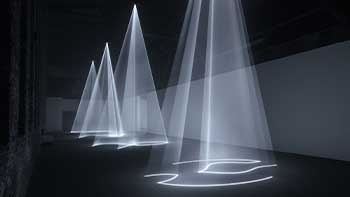
Anthony McCall’s films are not content to remain on a screen. In his installations, projection becomes a volume: a beam that can be entered, crossed, and watched as it changes slowly through space. The Centre Pompidou’s presentation of four monumental works at Ircam’s Espace de projection, announced for ManiFeste-2026 and Nuit Blanche, brings that proposition back to its essential question: what happens when cinema becomes something a body can occupy?
When projection leaves the frame
McCall’s breakthrough came in 1973 with Line Describing a Cone, a work now held in the Centre Pompidou collection. A simple circular line is projected into a smoke-filled room, where the beam becomes visible as a gradually forming cone. The image is no longer a representation of space; it produces a space of its own.
That reversal is the foundation of McCall’s “solid light” films. As the Centre Pompidou’s interview explains, the early works were made through deliberately modest means: gouache drawings on black paper, photographed frame by frame onto 16 mm film. The result is a moving geometry that unfolds almost imperceptibly. Projection does not support an image from elsewhere; it becomes the event the viewer is there to experience.
McCall’s practice sits between experimental cinema, minimalist sculpture, and installation. That classification is useful only up to a point. A film normally controls what a viewer sees from a fixed position, while a sculpture occupies a shared room. McCall joins the two without resolving the tension. The work has a programmed duration, but the experience changes according to where someone stands, how they move, and whether other visitors interrupt the beam.
The viewer becomes part of the image
The physical behavior of the work is not an effect added after the concept. It is the concept. Smoke makes the light visible; darkness isolates it; movement turns a stable projection into a changing relationship between bodies and form. A visitor can look at the cone from outside, pass through it, or watch another person alter its apparent shape. The artwork remains the same file or film, but no two encounters occupy the same position in the room.
This is why McCall’s work remains relevant to digital-art conversations even when it predates the current language of immersive media. The installation does not claim that technology produces immersion automatically. Instead, it makes the conditions of immersion explicit: a projector, a surface or atmosphere that catches light, a room, a duration, and people willing to share it. The technical apparatus is visible precisely because the work has not hidden its dependence on it.
There is also a quiet resistance to spectacle here. The forms move slowly, demanding attention without promising constant novelty. In an era of endlessly refreshed images, that slowness gives the viewer something rare: time to notice perception itself. McCall’s light is “solid” only as an experience, held together by the encounter between material conditions and human attention.
The Centre Pompidou’s presentation therefore offers more than a historical survey. It stages a live argument about images: that projection can be a sculptural medium, that cinema can be entered, and that the viewer’s body is not outside the work but one of its instruments.
Source: Centre Pompidou, “Anthony McCall: When Light Takes Form.”