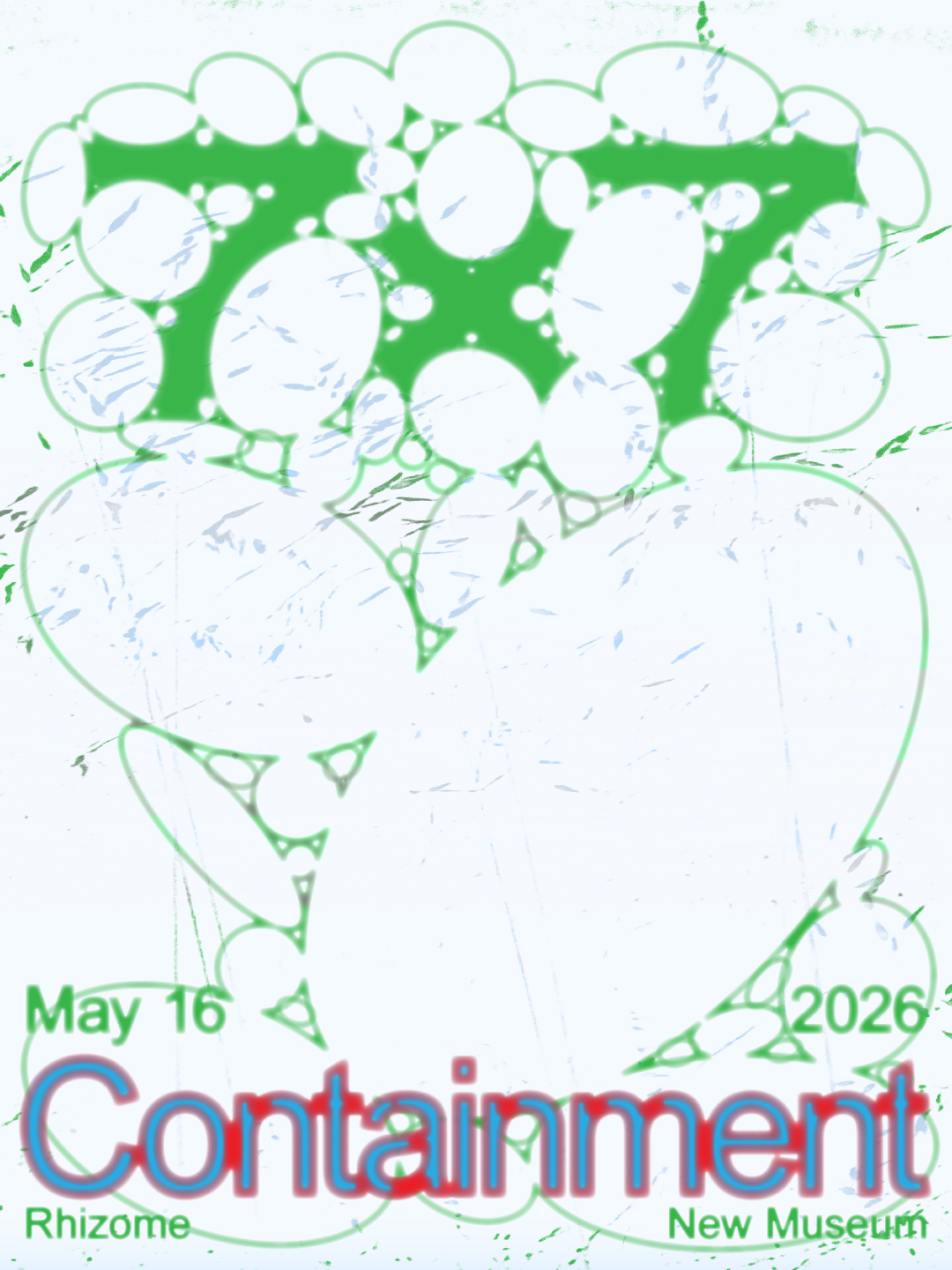
The New Museum’s 2026 edition of Seven on Seven (7×7) treated “containment” not as a safety slogan, but as a question for artists and technologists to test in public. Organized by Rhizome, the museum’s digital-art affiliate-in-residence, the day-long program brought seven artists together with seven technology collaborators on May 16 for a simple assignment: make something new.
That premise is deliberately open. Since its launch in 2010, 7×7 has used a public conference as a kind of pressure chamber: participants have one day to form a collaboration, develop an idea, and present the result. The outcome may be an app, prototype, performance, or artwork. Some projects continue after the event, but the format keeps experimentation—not polish—as its central measure.
For 2026, the program’s title carried a double meaning. “Containment” is commonly associated with efforts to make artificial-intelligence systems predictable and aligned with human interests. Rhizome and the New Museum instead connected the word to Zoe Sofia’s 2000 essay “Container Technologies,” shifting attention toward the systems that hold, organize, and condition life. The announced frame covered biological, financial, computational, and relational systems, with an emphasis on interdependence, care, study, and contingency.
That distinction matters for digital art. Much of the public conversation around AI still treats the technology as an isolated instrument—either an autonomous author or a productivity machine. A collaborative event built around containment points somewhere more useful: toward infrastructures, institutions, bodies, and social agreements. The question is not only what a model can generate, but who sets its boundaries, what those boundaries protect, and what they leave outside.
The curatorial structure reinforced that wider view. Rhizome organized the edition with Neema Githere and the research group 邊界 BiānJiè, represented by Elena Carbajal, Ian Margo, and Alexandre Montserrat. Githere’s practice examines digital diaspora and networked repair; Carbajal works across contemporary art, emerging technologies, and cultural theory; and the BiānJiè collaborators bring research into generative AI, sound, performance, speculative design, and digital media. These are not interchangeable “tech voices,” but different ways of describing how systems shape experience.
The program also included highlights from Rhizome’s ten-week Counterstructural Commons Residency, organized with the Mozilla Foundation. That addition connected the one-day sprint to a longer model of support, where research and making can develop through collective work rather than a single spectacular demonstration. It also placed 7×7 within Rhizome’s broader institutional role: commissioning, exhibiting, and preserving born-digital culture while treating the internet as an artistic and political environment.
The New Museum’s setting added another layer. The 2026 edition was the first 7×7 held there after the opening of the museum’s OMA/Shohei Shigematsu and Rem Koolhaas-designed expansion. In that context, the program was more than a conference attached to a museum. It was a test of whether a contemporary-art institution can make room for provisional, collaborative, technologically entangled work without forcing it into the finished language of the exhibition.
Whether any individual prototype survives beyond the event is not the only measure of success. The durable contribution of 7×7 may be its method: pair different forms of expertise, impose a modest constraint, and let the public see ideas before they harden into products. For digital art, that is a meaningful institutional gesture. It makes collaboration itself—not technological novelty—the work on view.