William Mapan’s Paysages Plausibles treats landscape as a provisional system assembled between painting, code, machines, and attention.
- Hand-painted panels and plotted works share the same inquiry.
- Algorithms introduce surprise without replacing the artist’s judgment.
- Collectors encounter constraints and process, not only finished images.
William Mapan’s Paysages Plausibles begins with a familiar art-historical problem: how do you make a landscape when the thing you are trying to see is already unstable? Mapan’s answer is neither a return to pastoral painting nor a celebration of software for its own sake. He builds landscapes as provisional systems, moving between oil, drawing machines, hand sketches, and code until an image feels possible without becoming fixed.
The series, presented by Art Blocks in its account of the project, is made from both hand-painted works and live machine-plotted pieces. That combination matters. Mapan is not using code to imitate a painterly surface; he is treating computation as another way of looking, one that can return unfamiliar structures to the artist and force a new decision.
A Landscape Made of Provisional Views
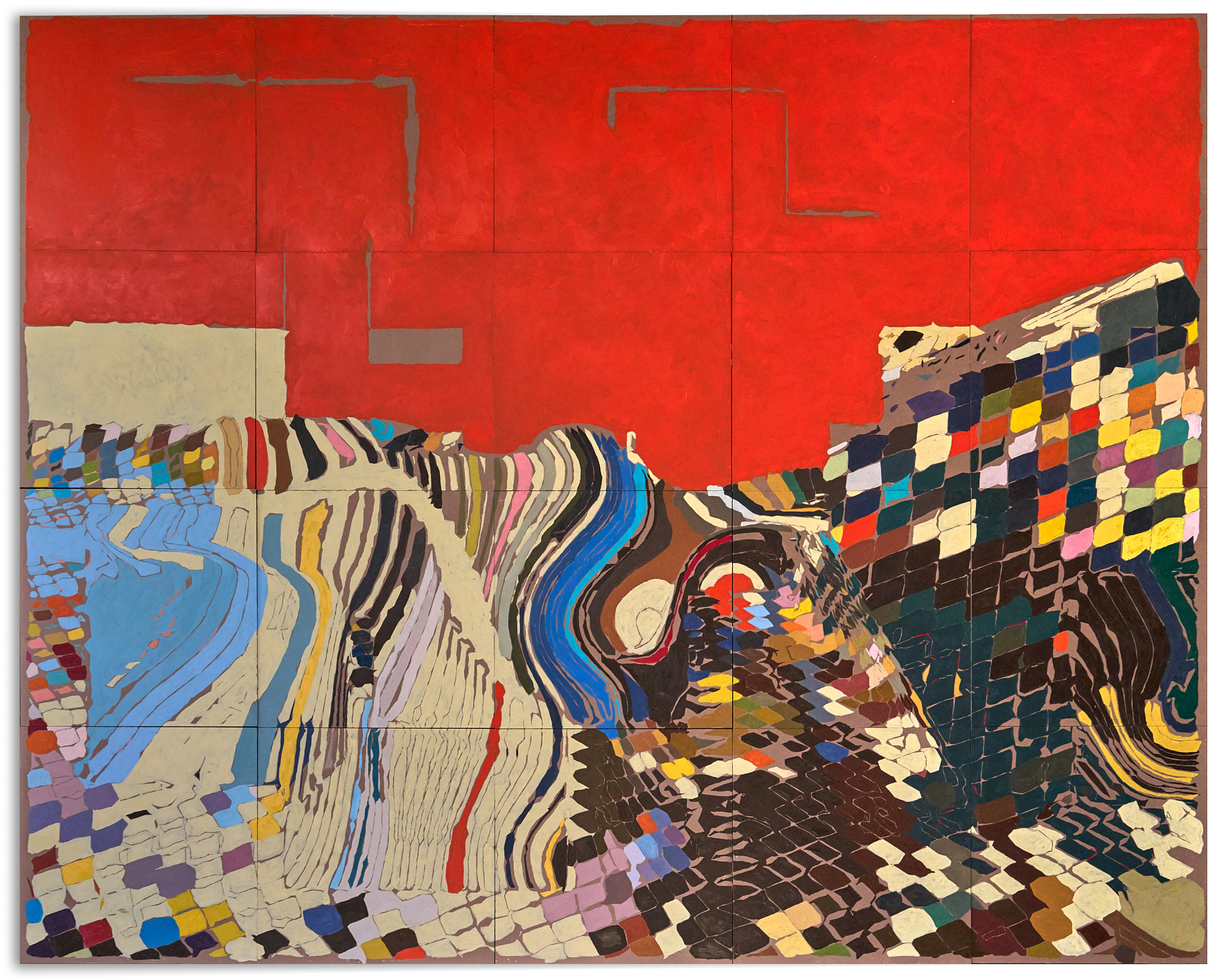
One of the clearest expressions of that approach is État des lieux, a 2026 oil painting assembled from twenty individually painted wood panels. At 250 by 200 centimeters, it reads less like a window onto a single place than like a field of competing viewpoints. Shapes suggest a coast, a mountain, or the edge of a built environment, but the work refuses to settle into one answer. Mapan has described these images as “surrealist theatres”: scenes whose elements are deliberately arranged to make recognition possible, while leaving interpretation open.
That tension places Paysages Plausibles in conversation with Paul Cézanne, David Hockney, and Helen Frankenthaler, artists whose influence Mapan acknowledges through structure, color, and the willingness to make seeing itself visible. The comparison is useful, but not because Mapan is reenacting modernist painting. His landscapes inherit a question from that history—whether a picture can show more than one way of seeing at once—and route it through a contemporary toolset.
Mapan’s process is deliberately layered. He begins with drawings and visual elements, then writes rules that can assemble and rearrange shapes, textures, colors, and spaces. Randomness enters inside those boundaries. The algorithm can surprise him, but it cannot decide what the work is about. The artist establishes the conditions under which an image may occur, then evaluates the results through the eye and the hand. In that sense, the code is neither an autonomous author nor a neutral brush. It is a collaborator with sharply limited powers.
When the Plotter Shows Its Work
The plotted works make that collaboration physical. In the related DOS (Dances on Shadows) collection, a landscape is drawn on paper and covered with a pastel layer on tracing paper. The two surfaces allow ground and gesture to remain separate while still being read together. A plotter’s mechanical repetition becomes a record of movement: contour, pause, displacement, and the residual trace of a machine following instructions.
Time is part of the work’s meaning. Art Blocks says each live plotter drawing can take roughly two hours to complete. That duration counters the mythology of instant digital production. The machine does not make the work disappear into automation; it makes the sequence of its making unusually legible. Viewers can watch a rule become a mark, and a mark become an image that still has not completely decided what it represents.
There is also a modest but important shift in the role of the collector. For the online DOS works, collectors can explore Mapan’s generative application and produce iterations before some are adopted into the final collection. The transaction is therefore not simply a purchase of a finished picture. It is an encounter with the artist’s constraints—an opportunity to see how much freedom can exist inside a carefully designed system.
Paysages Plausibles is most compelling when it keeps its mediums in friction. The paintings borrow from computation without looking like screenshots; the plotted drawings turn code into a slow, tactile event; the NFTs preserve a path into a system rather than merely certifying an image. Mapan’s real subject is not the landscape as scenery. It is the landscape as a negotiated act of attention—something assembled between rules, accidents, materials, and the viewer’s desire to make a place out of uncertainty.