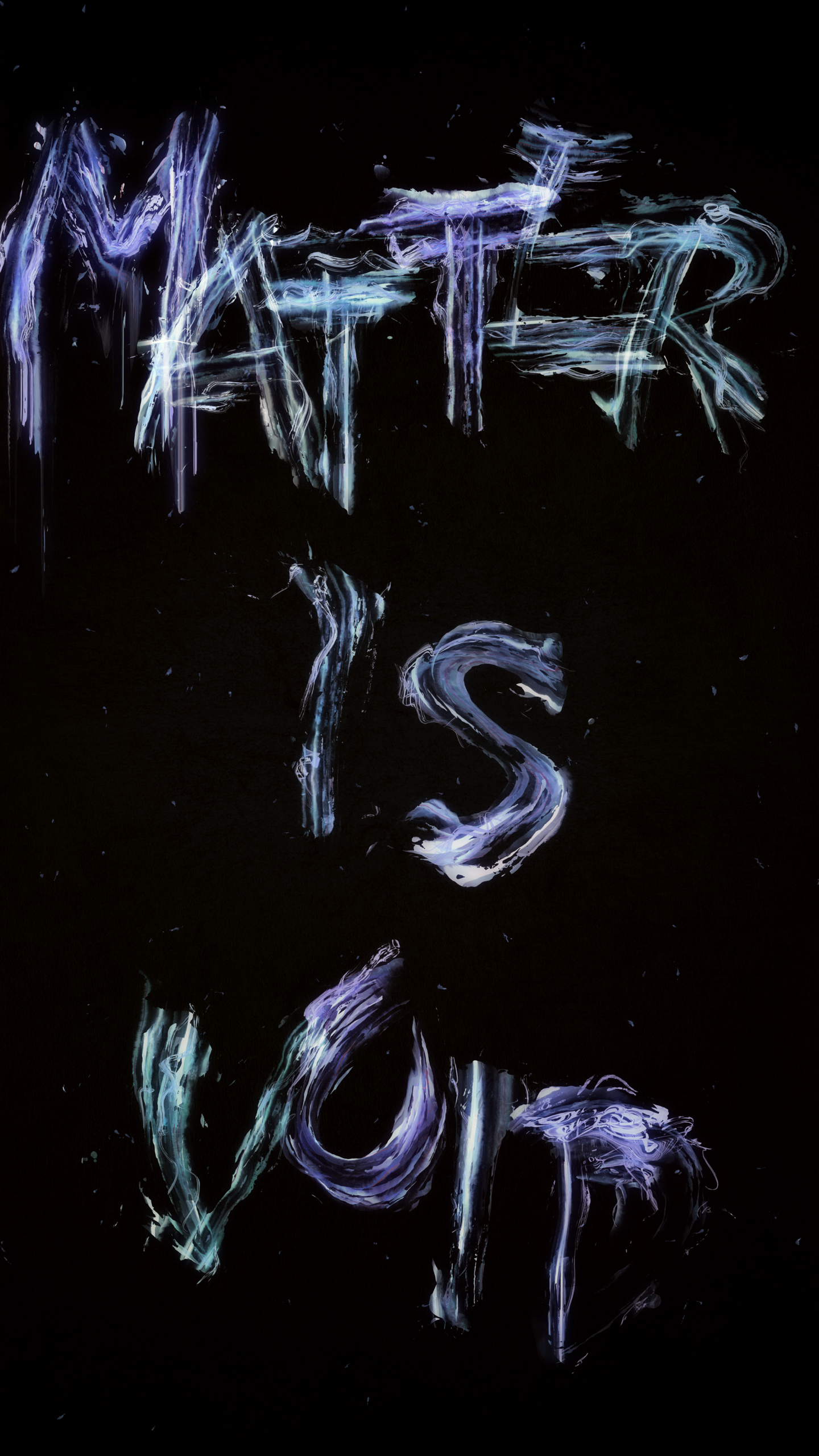
Matter is Void makes NFT ownership a right to alter a public artwork, not a claim of exclusive visual possession. The project uses scarcity to limit authorship while keeping the finished experience open to the public.
- Seven NFTs let their buyers change the work’s displayed phrase.
- Once altered, each version remains downloadable and equally authentic to everyone.
- Its moving brushstrokes turn language into a temporary, software-based event.
teamLab’s Matter is Void begins with a proposition that sounds almost too simple for an NFT: the work can be downloaded by anyone, but only seven buyers can change the words inside it. The result is less a digital object than a shared image whose meaning is altered by a very small group of owners.
A Public Image With Seven Editors
Presented by Pace Verso in 2022, the project was the interdisciplinary collective’s first NFT. Its seven versions—black in white, black in black, white in white, gold light, fire, water, and fog—animate brushstrokes that float through space before briefly coalescing into the phrase “Matter is Void.” The reference is to Shikisoku Zekuu, the Buddhist formulation that links form and emptiness.
The work’s unusual rule arrives after the sale. Each purchaser can replace the displayed phrase through a website created by teamLab. Once changed, an NFT never returns to its original state. The intervention is therefore irreversible, but it is not private in the usual sense: the altered artwork remains available for anyone to download and display. A collector owns the right to modify one version, while the resulting image is deliberately distributed beyond the collector’s wallet.
Scarcity Moves From Access to Agency
That structure unsettles the familiar NFT promise that ownership is proved by scarcity. Matter is Void keeps scarcity at the level of agency rather than access. Seven people control the work’s textual mutation; everyone else can encounter the same mutation as an equally authentic display. The distinction is closer to holding a permission inside a public artwork than possessing a singular file.
It also gives the project a more precise account of participation than the language of “community” usually offered by web3 launches. The buyer does not merely receive a token or a seat at a future event. The buyer performs a one-time act that changes the work’s future behavior, and the public inherits the consequence. The artwork’s life is split between a private decision and a common view.
Spatial Calligraphy Makes Language Temporary
Visually, the system grows out of teamLab’s longstanding interest in what it calls Spatial Calligraphy: brushwork released from the flat surface and allowed to move through a simulated environment. Legibility is temporary. Letters gather, hold together long enough to be read, then dissolve into choreography. The phrase is not a caption placed on top of an animation; it is a transient state produced by the animation itself.
A Collectible That Still Needs a Computer
The project’s technical requirements reinforce that it is meant to be experienced as software rather than as a static collectible. teamLab’s official download page lists separate Windows and Mac installations, a 4K display, a discrete high-end GPU for Windows, and an internet connection. Those specifications make the work’s “ownership” inseparable from the conditions of running it: the collector receives a system to install and operate, not just an image to archive.
Matter is Void is consequently most interesting where its commercial form contradicts itself. It uses seven NFTs to restrict authorship, then refuses to restrict the resulting experience. The work asks whether a blockchain token has to make an artwork exclusive to make ownership meaningful. teamLab’s answer is careful rather than utopian: ownership can be the right to change a public image, while authenticity belongs to everyone who encounters the change.