Des Lucréce’s BitMON Hong Kong turns a digital-art release into a small ritual of opening, claiming, and collecting.
- The Verse series was the official Art Basel Hong Kong 2026 release.
- Collectors begin with a sealed foil-pack token.
- The project links a trading card, NFC object, NFT, and optional print.
Des Lucréce’s BitMON Hong Kong does not begin with an image on a marketplace grid. It begins with the promise of a sealed object. Released through Verse as the official Art Basel Hong Kong 2026 digital release, the project borrows the suspense of a trading-card pack and routes it through blockchain infrastructure, making the act of discovery part of the artwork’s collecting logic.
From foil pack to NFT
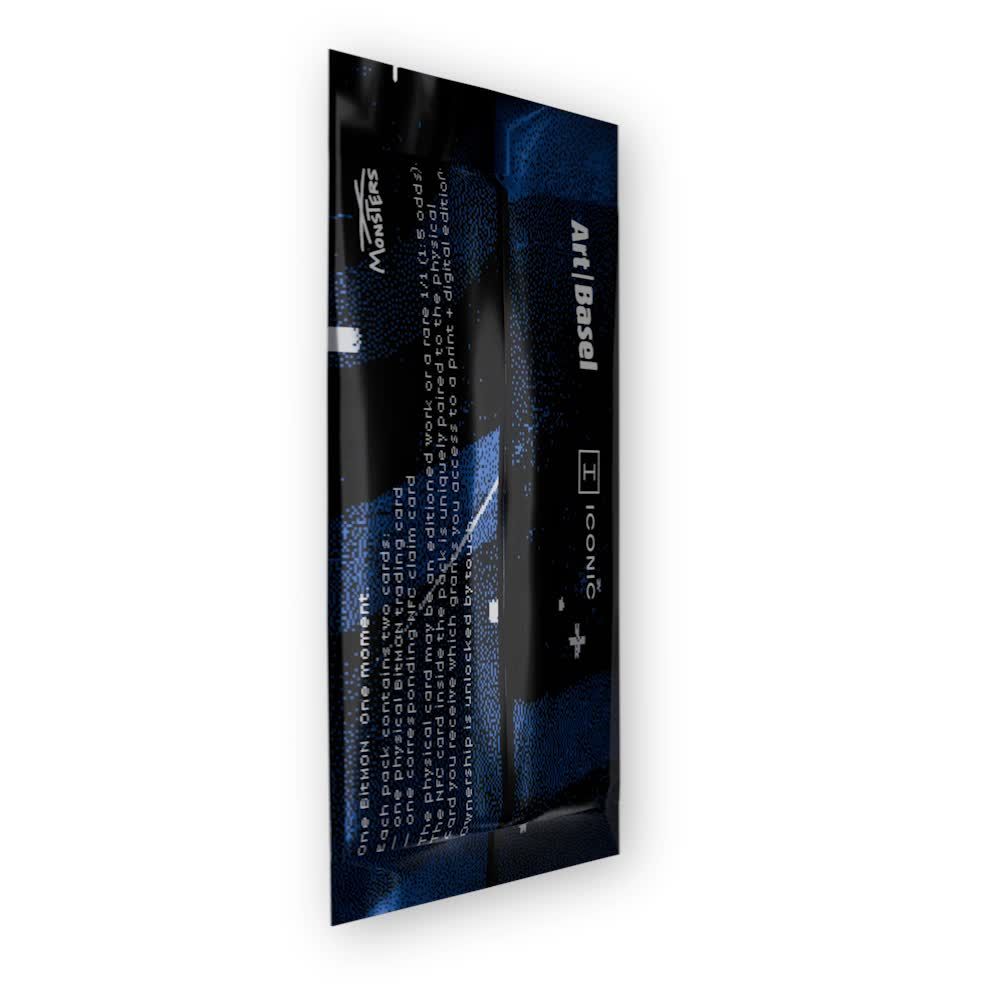
On Verse’s series page, the initial token is described as a sealed BitMON foil pack. Collectors burn that token through the ICONIC claim portal to receive a physical pack. Inside are a collectible trading card and an NFC-enabled Art Card, which can be used to claim the corresponding NFT. The release therefore separates access from the final digital work: the first transaction grants a possibility, while the later act of opening determines what the collector actually receives.
That structure is more elaborate than the usual “physical plus digital” bundle. The foil pack provides an element of chance and ceremony; the NFC card supplies a bridge between a tangible object and a verifiable token; the NFT records the digital result. Verse also says collectors can purchase a matching hand-signed and numbered fine-art print tied to their specific BitMON trading card. Each layer carries a different kind of value—surprise, proof, display, and material presence—without pretending they are interchangeable.
The series page lists 86 items on Ethereum using the ERC-721 standard. It also reports 32 owners, two listings, $8,465 in sales volume, and a highest sale of $286 at the time of access. Those figures describe a small market rather than a breakout event. That scale is useful context: BitMON Hong Kong is interesting less as a financial phenomenon than as a test of how many steps collectors will accept when the point of a digital artwork is partly the experience of getting to it.
Collecting as a sequence of actions
Lucréce’s project sits between contemporary art, trading-card culture, and digitally authenticated merchandise. Its key move is to make ownership procedural. A collector does not simply acquire a finished file; they burn, open, scan, claim, and potentially order a print. The work’s identity is distributed across those actions, even though the blockchain remains the system that ties the pieces together.
That approach also makes the release legible to audiences who may be more familiar with physical collectibles than with generative or tokenized art. The foil-pack format offers an immediate metaphor for scarcity and surprise, while the NFC card translates digital verification into a gesture that can be performed with an object in hand. The result is not a rejection of NFT conventions but a theatrical rearrangement of them.
The risk is that the choreography could become more memorable than the art. A successful collectible ritual needs a visual language strong enough to survive after the pack is opened and the claim is complete. BitMON Hong Kong will be judged on that second life: whether the trading card, NFT, and print feel like related expressions of Lucréce’s world rather than checkpoints in a sales funnel.