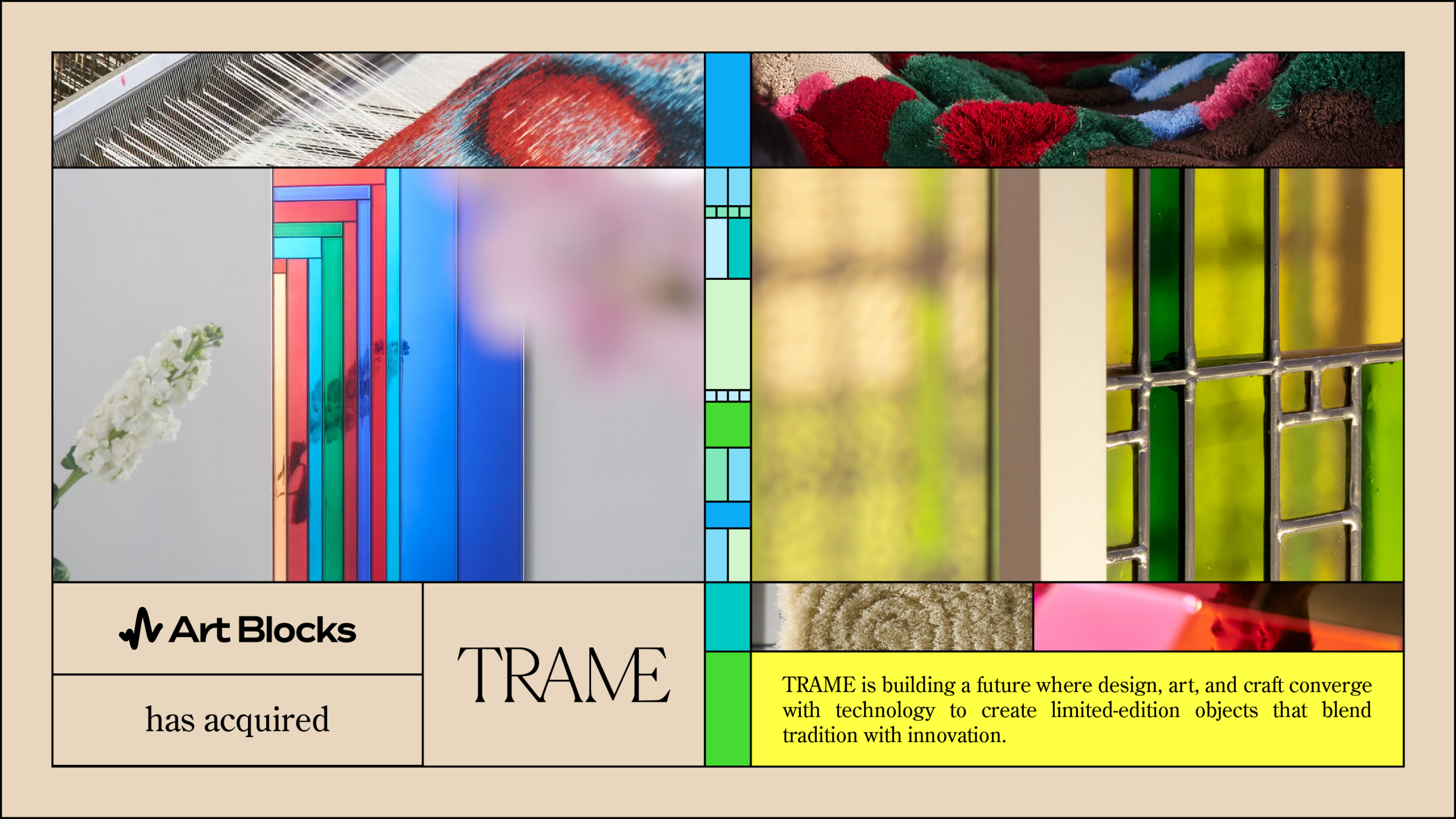
Art Blocks’ proposed acquisition of Trame Paris points to a version of generative art that does not stop at the screen. Announced in July 2025, the deal would bring a Paris-based design studio known for translating algorithms into glass, textiles, furniture, and other crafted objects into the same company that operates one of the best-known platforms for blockchain-based generative art.
From generator to workshop
Art Blocks described Trame as a studio that fuses heritage craft with algorithms. Its announcement says Trame’s collections have been built on Art Blocks Engine since 2022, a detail that matters more than the language of “digital meets physical.” The two businesses were already connected at the infrastructure level; the proposed acquisition would make that relationship organizational as well.
On its own About Us page, Trame describes a practice spanning algorithmic artists, product designers, and master artisans. The studio says projects can move from code into glass, textile, or wood, while its limited-edition works are meant to explore how memory, cultural heritage, and computational tools can coexist in material form.
Why the structure matters
Generative art has often been discussed as a choice between a native digital edition and a physical derivative. Trame proposes a less tidy relationship: the algorithm is not simply used to produce an image that is later printed or manufactured. It becomes part of a chain of decisions involving artists, designers, workshops, materials, and techniques.
That chain is visible in the kinds of objects named in Art Blocks’ announcement: Venetian glass mirrors, stained-glass sculptures, wall tapestries, and handwoven café chairs. The company also points to craft relationships in Aubusson, Chartres, and Venice. Those details suggest a production model in which the “output” is not one standardized object but a negotiated translation between a digital system and a particular material process.
There is a useful distinction here. Code can determine a pattern, arrangement, or set of variations; it cannot, by itself, perform the labor of weaving, glassmaking, or woodworking. Trame’s proposition is therefore not that computation replaces craft. It is that computation can become one participant in a craft process, alongside human judgment and the constraints of a workshop.
A broader collecting proposition
Art Blocks framed the acquisition as a way to connect a range of products, from educational kits to luxury pieces priced above $25,000. Those figures come from the company’s own announcement and should be read as a description of its intended market coverage, not as proof that a new market has already been established.
A secondary interview with Trame co-founder Ismail Tazi, published by Le Bon Marché, offers a compatible but more grounded account of the studio’s rationale. Tazi said the goal was to develop “a new digital craftsmanship” in which technology enhances rather than displaces design professions. The interview discusses a collaboration with digital workshop Fab.Pub and a collection called Alhambra.gcode, placing Trame’s ambitions within an existing design and retail context.
The unresolved question is whether vertical integration will make generative art more meaningfully accessible or simply extend luxury design’s vocabulary into Web3. The answer will depend on what Art Blocks and Trame actually produce together: whether collectors encounter objects with genuine material intelligence, or merely physical goods wrapped in algorithmic provenance.
For now, the proposed acquisition is significant because it treats generative art as a production ecology rather than a file format. It links the token, the generator, the designer, and the craftsperson without pretending that any one of them can stand in for the others. That is a more demanding proposition than “bringing digital art into the real world”—and a more interesting one.