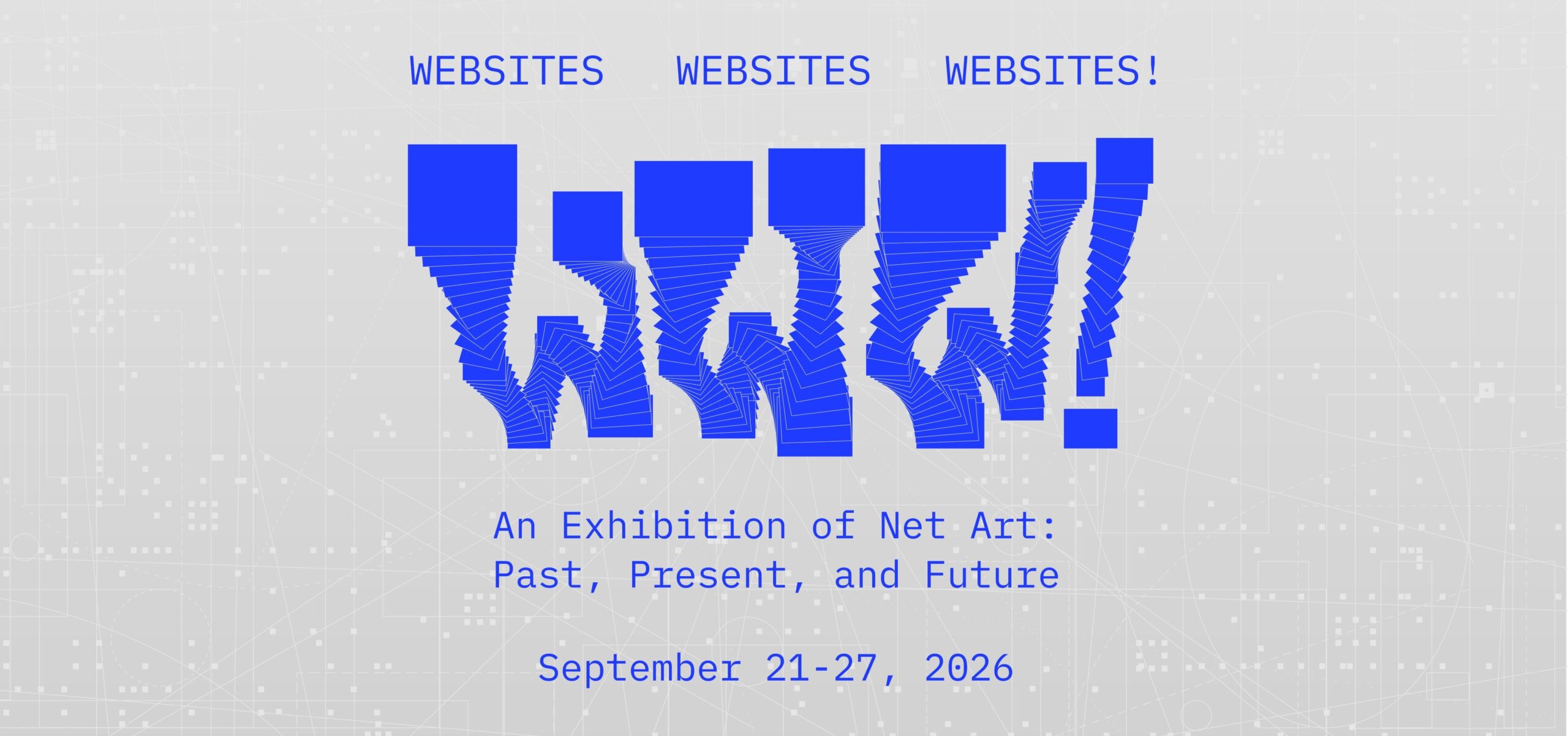
WEBSITES WEBSITES WEBSITES! treats the open web as both an exhibition space and a fragile material for collecting.
- Twenty artists’ works remain publicly accessible as websites.
- Ownership can transfer a domain without closing access to viewers.
- Preservation still depends on infrastructure, documentation, and technical care.
Rhizome’s 30th-anniversary exhibition, WEBSITES WEBSITES WEBSITES!, closed its New York run on September 27, but most of the art never left the place where it was made: the open web. That distinction matters. The show paired a physical installation of screens, projections, old desktops, and touchscreens with an online exhibition of 20 artists. It also offered the works for sale through Fellowship.
The combination posed a practical question that paintings rarely have to answer. What does a collector acquire when the artwork is a public URL?
A website is more than its screen
Organized by Rhizome and ARTXCODE, and curated by Sofia Garcia with LAN Party’s Vienna Kim and Benoit Palop, the exhibition ran at New Int. Picture Company in New York from September 21 through 27. Its online version remains accessible, grouping works under four loose themes: Anarchy, Abstraction, Poetic Computing, and Ghosts.
The physical display made browser art tangible without pretending that a monitor was the work. An independent installation report described Auriea Harvey’s Wrong! and Jan Robert Leegte’s untitled[rhizome] as works that use errors and absence to expose the website as a constructed object. The hardware supplied historical texture. The art still depended on code, network requests, browser behavior, and the continued existence of an address.
That dependency complicates the organizers’ claim that a website “belongs to no platform and answers to no algorithm.” A standalone domain does offer more autonomy than an Instagram account or a marketplace profile. It does not escape infrastructure. Registrars, hosting companies, software libraries, security certificates, and browser updates can all determine whether a work remains available or behaves as intended.
Collecting without closing the gate
The Fellowship catalogue showed several kinds of transaction rather than a single model. Seven works were marked sold when checked after the exhibition, while others remained available by inquiry. Rafaël Rozendaal’s 2006 work papertoilet was listed as exhibition-only and sold privately. Fellowship’s account of Rozendaal’s practice explains the underlying bargain: ownership passes through the domain, the collector’s name enters the browser title bar, and the work stays publicly accessible.
Public access is not a concession in that model. It is part of the work. The collector owns a position of stewardship and recognition, not an exclusive viewing room.
Exonemo’s The Last Acres of the Internet makes that proposition more unruly. The duo registers 63-character domain names, the maximum length allowed for a single label, and fills each with an HTML wilderness generated from random strings. Its buyer receives the domain and may build on the “land.” The auction opened at $24, borrowing the familiar and contested story of Manhattan’s purchase as a joke about digital real estate. Here, the address is at once title, location, material, and deed.
Other works resist such a neat package. Sarah Friend’s FEED lets a Pac-Man-like creature consume any website a visitor enters while dodging CAPTCHA bombs. The piece draws its meaning from live external pages and from current anxieties about AI crawlers, scraping, and link rot. A sale can establish ownership, but it cannot make those dependencies stand still.
A purchase needs a preservation plan
The exhibition’s strongest argument arrives after the sales platform has done its work. A net-art acquisition is incomplete if it records only buyer, price, and token or domain. Collectors also need to know what must remain stable: source files, server software, database behavior, third-party services, browser versions, domain registration, and the artist’s instructions for future change.
Rhizome has learned this through its own archive. The organization says its early ArtBase accepted “linked” works that remained on artists’ servers, but unstable access eventually led it to stop accessioning them. Its current preservation services include isolated legacy servers, period software environments, web archiving, and encapsulated copies designed to remain accessible outside Rhizome’s own infrastructure.
That history sharpens the show’s case for website autonomy. Owning the address can protect an artwork from the rules of a social platform. Preserving the work demands something less romantic: documentation, backups, technical custody, and an agreement about what may change. The website can remain public and still be collected. The harder task is ensuring that it remains itself.